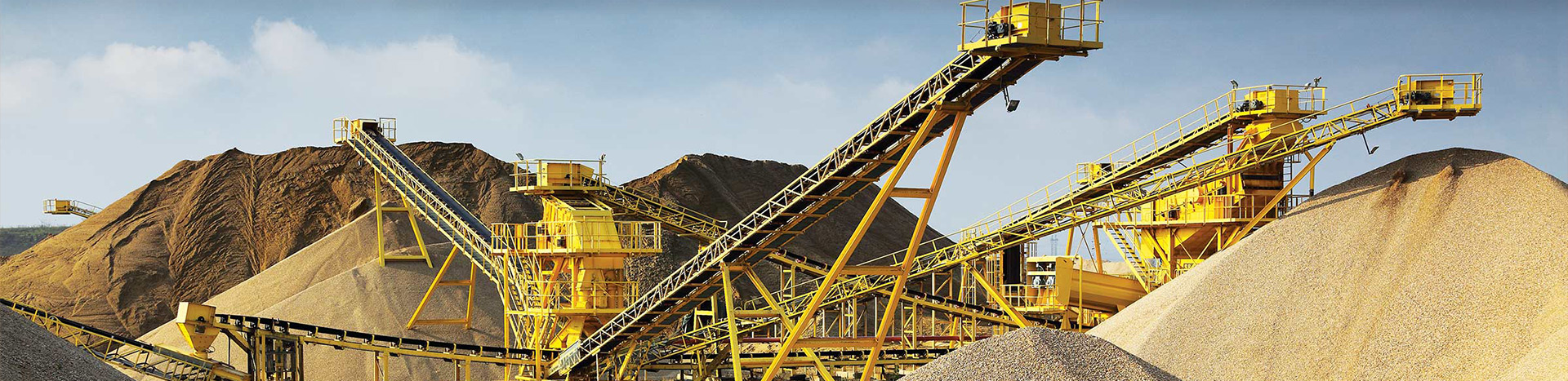
As the core sorting equipment in the industrial field, mining screens are used throughout the entire process from raw material processing, production and processing to waste recycling. Through precise screening , efficiency improvement and resource optimization , they have become an indispensable "technological link" in the modern industrial system.
1. Raw material pretreatment and grading
( 1 ) Metal smelting:
In the metallurgical industries such as iron ore and copper ore, ore screens are used to classify the particle size of crushed ore (such as 0-10mm charging material and 10-30mm return material) to ensure the air permeability and smelting efficiency of blast furnaces or electric furnaces.
effect:
Improve metal recovery rate (e.g. iron ore grade increased by 5%-8% after screening);
Reduce coke consumption (uniform particle size reduces "bridging" phenomenon in the furnace).
( 2 ) Chemical raw material processing:
Screening of catalyst carriers (such as alumina balls), plastic particles, and fertilizer raw materials to control particle size distribution (such as urea particles 1-4mm) to ensure uniformity of chemical reactions.
effect:
Avoid pipe blockage caused by agglomeration;
Improve catalyst activity (such as molecular sieve particle size error ≤ 0.05mm).
2. Precision production in manufacturing
( 1 ) Powder metallurgy:
Screening of metal powders (such as titanium powder and tungsten powder) to a specific particle size (such as below 200 mesh) for precision manufacturing such as 3D printing and MIM (metal injection molding).
effect:
Ensure consistency of product density and mechanical properties;
Reduce sintering deformation (coarse particle ratio ≤ 0.1%).
( 2 ) Electronic materials:
Sorting silicon micropowder (raw materials for photovoltaic cells), ceramic dielectrics (MLCC capacitors), etc., with precision reaching nanometer level (such as 325 mesh sieve filtering 5μm particles).
effect:
Improve the yield rate of electronic components (e.g., the defect rate of MLCC capacitors is reduced by 30% after screening);
Meet the ultra-high purity requirements of semiconductor materials (impurity content ≤ 1ppm).
3. Environmental protection and resource recycling
( 1 ) Industrial solid waste treatment:
Sorting industrial wastes such as fly ash, steel slag, and red mud to extract recyclable components (such as iron particles in steel slag and floating beads in fly ash).
effect:
The resource utilization rate increased to over 60%;
Reduce landfill costs (reduced by US$50-100 per ton of solid waste disposal fees).
( 2 ) Wastewater treatment:
Use stainless steel mesh (pore size 0.1-1mm) to intercept suspended solids in industrial wastewater (such as textile printing and dyeing fibers, electroplating sludge).
effect:
Protective membrane treatment system, extending the life of reverse osmosis membrane by 2-3 times;
Comply with industrial wastewater discharge standards (such as SS≤30mg/L).
4. Food and pharmaceutical industries
( 1 ) Food processing:
Sifting flour, powdered sugar, milk powder, etc. to remove lumps or foreign matter (such as metal shavings) in compliance with HACCP food safety standards.
effect:
Ensure product fineness (such as flour passing through a 100-mesh sieve);
Prevent consumer complaints and recall risks caused by foreign matter.
( 2 ) Pharmaceutical industry:
Use 316L stainless steel vibrating screen to grade drug powders and granules (e.g. 20-60 mesh) to meet GMP clean room requirements.
effect:
Controlling drug dissolution rate (particle size affects bioavailability);
Avoid cross contamination (fully enclosed screening design).

1. Mainstream screening equipment
Ultrasonic vibrating screen:
Applicable scenarios:
Ultrafine powders (such as graphene, carbon nanotubes), highly viscous materials (such as ointment raw materials).
Technical advantages:
Ultrasonic high-frequency vibration completely solves the problem of hole blocking, and the screening accuracy reaches more than 500 meshes.
Airflow screen (cyclone screen):
Applicable scenarios:
Light powders (such as titanium dioxide, starch), and materials that easily generate dust.
Technical advantages:
No mechanical vibration, screening is driven by airflow, suitable for explosion-proof environment (such as chemical dust).
Centrifugal sieve:
Applicable scenarios:
High-moisture fibrous materials (such as paper pulp and food processing waste).
Technical advantages:
Centrifugal separation combined with screen filtration, with a processing capacity of 20 tons/hour.
2. Screen material selection
( 1 ) Metal screen:
Stainless steel (304/316L): food and medical grade, corrosion resistant;
High carbon steel: metallurgy and mining industries, strong impact resistance.
( 2 ) Non-metallic screen:
Polyurethane: Its wear resistance is 5 times that of steel mesh, suitable for abrasive materials such as quartz sand;

1. Iron and Steel Industry ( Baosteel Group ) :
Multi-layer probability screening is used to select blast furnace slag, producing 0-5mm fine powder for cement admixtures, with an annual processing capacity of 2 million tons and generating revenue of 120 million yuan.

2. Lithium battery industry (CATL):
An ultrasonic vibrating screen is used to screen the lithium cobalt oxide positive electrode material (D50=8μm) to ensure battery consistency and increase the yield rate to 99.3%.

3. Pharmaceutical companies (Pfizer):
A fully enclosed stainless steel vibrating screen for packaging azithromycin granules complies with FDA 21 CFR Part 11 electronic record regulations, increasing annual production capacity by 40%.
The mining industry, with its rigorous demand for precision and efficiency in material processing, significantly benefits from advancements in screening media technology. Screening media, the workhorse behind material separation and classification, plays a pivotal role in ensuring the quality and consistency of mined materials.Red Star Wire Mesh manufactures complete standard and custom solutions for the Mining industry. We also offer mining supplies and overall wear parts.
Find out more about our products made specifically for mining market:
Our experienced staff is available to discuss your needs and to help determine which product is best for your particular application.
Request a quote or call us at +86 13673237939

Factory Address:
1 Hongxing Rd, Anping County, Hengshui, Hebei, China

Email:
[email protected]
WhatsApp :
+86 13673237939
Phone:
+86 13673237939

:

Working Hours:
Monday – Friday: 8:00 AM – 5:00 PM (GMT+8). We reply to all inquiries within 12–24 hours, regardless of time zone.