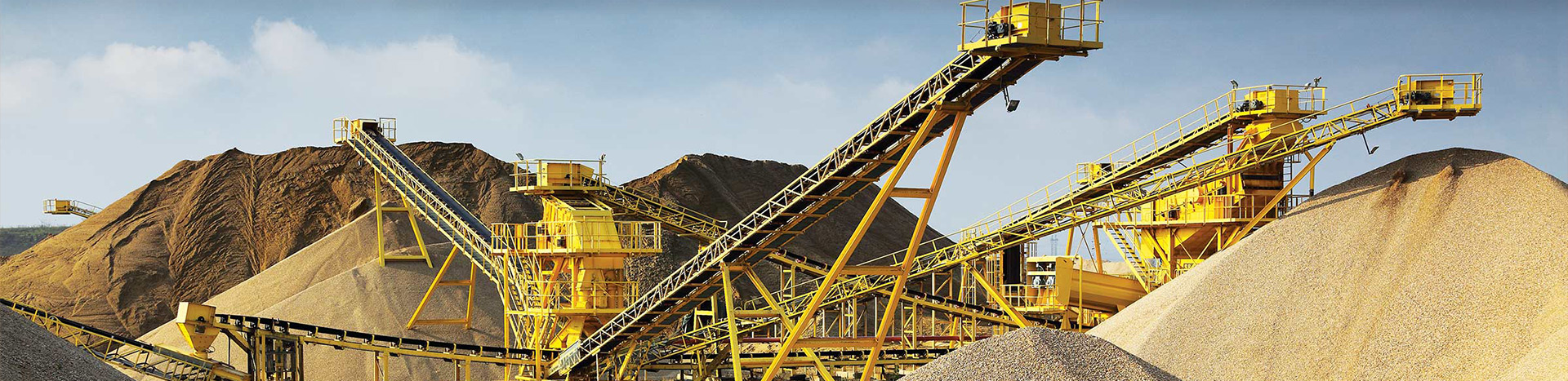
Mineral screens play a vital role in the construction industry, particularly in sand and gravel aggregate production, concrete preparation, construction waste recycling, and environmentally friendly building material processing. Their application not only improves the quality of building materials and engineering efficiency, but also contributes to the realization of green building and sustainable development goals.
(1) Sand and gravel aggregate production
Functional requirements:
Aggregates of sand and gravel used in construction must meet strict grading standards (such as the fineness modulus of sand for concrete and the distribution of crushed stone particle size). The ore screen uses multi-stage screening (coarse crushing, medium crushing, and fine crushing) to grade natural ore or machine-made sand according to particle size to ensure that the aggregates meet the needs of different projects (such as C30 concrete, roadbed filling, etc.).
effect:
Improve concrete strength: Accurate screening reduces coarse or fine particles and optimizes aggregate grading;
Reduce cement usage: Reasonable grading reduces aggregate void ratio and saves cementitious material costs.
(2) Construction waste recycling and reuse
Crushing and screening system:
Mineral screens are used to sort construction waste (concrete blocks, bricks, tiles, steel bars, etc.), separate recyclable aggregates from impurities, and produce recycled aggregates (such as RCA recycled concrete aggregates) for road bases, non-structural concrete, etc.
effect:
Reduce landfill volume: the recycling rate of construction waste has increased to over 70%;
Save natural resources: replace natural sand and gravel to alleviate the pressure of resource shortage.
3) Environmentally friendly building materials processing
A. Screening of lightweight building materials:
In the production of lightweight aggregates such as expanded perlite and ceramsite, mineral screens are used to control particle size to ensure that thermal insulation and sound insulation performance meet standards.
B. Screening of decorative materials:
Screening of natural stone fragments (such as marble and granite) for use in artificial stone slabs or landscape paving to increase added value.
(4) Ready-mixed concrete and dry-mixed mortar
Raw material quality control:
Screening of sand, fly ash, mineral powder and other raw materials to remove lumps or impurities to ensure uniformity and construction performance of concrete and mortar.

(1) Common screen types
A. Vibrating screen (linear screen, circular vibrating screen):
It is suitable for high-yield sand and gravel aggregate grading, with a processing capacity of up to 1,000 tons/hour. The multi-layer screen design (such as 3-5 layers) realizes the synchronous output of multiple particle sizes.
B. Drum screen:
Used for the preliminary sorting of construction waste, separating large debris and recyclable aggregates through a rotating screen drum.
C. High frequency screen:
Focus on fine sand recovery (such as stone powder control in machine-made sand) to reduce resource waste.
(2) Key performance requirements
A. Wear resistance:
Sand and gravel aggregates have high hardness (Mohs hardness 6-7), so the screen needs to be made of high manganese steel, polyurethane or rubber edging material to extend its service life.
B. Anti-blocking hole design:
During wet screening, a wavy screen surface or a bouncing ball screen cleaning device is used to reduce sand adhesion and clogging.
C. Modular structure:
Quickly change the screen specifications (such as 4mm, 10mm aperture) to adapt to different project requirements.

( 1 ) Quality Assurance:
By controlling the particle size of materials through screening, engineering problems such as concrete cracking and insufficient strength caused by unqualified aggregates can be avoided.
( 2 ) Cost optimization:
Reduce cement usage (reasonable grading reduces void ratio);
Reduce transportation costs (process construction waste on site and reduce the purchase of natural sand and gravel).
( 3 ) Environmental compliance:
Support the goal of "zero waste" for construction waste, reduce land occupation and environmental pollution;
It complies with the requirements of the Green Building Evaluation Standard (GB/T 50378) on the use of renewable materials.
( 4 ) Improved engineering efficiency:
Automated screening systems (such as intelligent vibrating screens) enable continuous operation and shorten the production cycle of building materials.
The mining industry, with its rigorous demand for precision and efficiency in material processing, significantly benefits from advancements in screening media technology. Screening media, the workhorse behind material separation and classification, plays a pivotal role in ensuring the quality and consistency of mined materials.Red Star Wire Mesh manufactures complete standard and custom solutions for the Mining industry. We also offer mining supplies and overall wear parts.
Find out more about our products made specifically for mining market:
Our experienced staff is available to discuss your needs and to help determine which product is best for your particular application.
Request a quote or call us at +86 13673237939

Factory Address:
1 Hongxing Rd, Anping County, Hengshui, Hebei, China

Email:
[email protected]
WhatsApp :
+86 13673237939
Phone:
+86 13673237939

:

Working Hours:
Monday – Friday: 8:00 AM – 5:00 PM (GMT+8). We reply to all inquiries within 12–24 hours, regardless of time zone.